
Chapter I-The Road North
Autumn, 1692
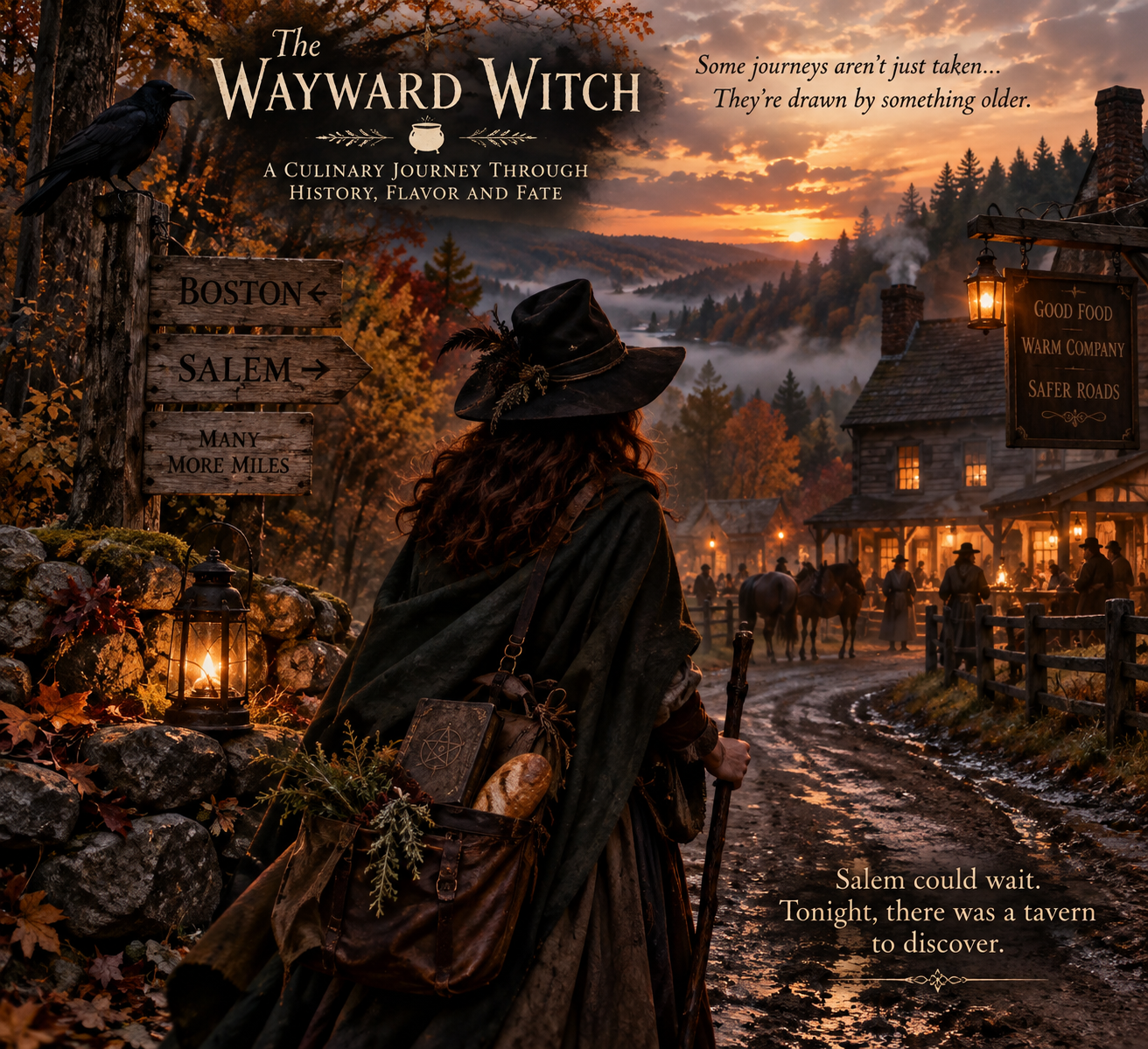
The first cold breath of autumn had found the Wayward Witch long before she found Massachusetts.
For three days she had followed a narrow road north, traveling beneath forests already burning gold and crimson. Her boots were muddied, her cloak smelled faintly of woodsmoke, and tucked safely inside her satchel were a few precious herbs, a heel of bread, and a folded scrap of parchment bearing only two words:
Salem. Massachusetts.
She wasn't entirely certain why she was going there. Perhaps that was what troubled her most.
Rumors traveled the road with the merchants and wagoners—whispers of accusations, frightened villages, strange happenings, and women whose names were spoken only after looking over one's shoulder. Something was stirring in Salem. And although every sensible instinct told her to turn south, something older seemed to be pulling her north.
But Salem was still many miles—and many adventures—ahead.
As dusk settled over the forest, rain began tapping against the leaves. Then, somewhere beyond the trees, she saw it: the flicker of lanterns and the crooked silhouette of an old roadside tavern. Through the gathering darkness came the smell of a wood fire, roasted meat, warm sage bread and apples touched with spice.
Her stomach answered before good sense could.
The Wayward Witch smiled beneath the shadow of her hood and stepped from the road toward the light.
Salem could wait. Tonight, there was a tavern to discover.
And so the journey begins…
Chapter II-The Harvest Moon Feast
The tavern appeared just as the last light disappeared behind the trees. Warm amber light spilled from its windows, and smoke curled lazily from the chimney. Inside, travelers crowded near the hearth while mugs struck wooden tables and the scent of roasted meat, herbs and fresh bread hung heavily in the air.
When the Wayward Witch entered, the old tavern keeper did not lead her toward the fire. He led her to the very last table. The one tucked into the shadows at the back of the room.
“You’ve come from the northern road,” he said quietly as he set down her supper and walked away.
Before her sat a steaming Wayward Witch Tavern Feast—tender lamb beneath golden pastry, earthy root vegetables, braised cabbage and warm honey-sage bread. For a while, she forgot the cold road ahead and simply ate.
Then the tavern keeper returned. He seemed distraught, almost paranoid as his eyes shifted back and forth and then locked her gaze.
“Strange things have been happening in the forest,” he murmured.
The laughter of the tavern suddenly seemed very far away. He told her of pale lights moving between the trees where no travelers walked. Of herbs growing green despite the coming frost. And of a cottage hidden so deeply among the pines that most who searched for it never found it.
“They say a Green Witch lives there,” he whispered. “And lately…the forest has begun waking around her.”
Before she could ask more, someone called for him from across the room. The old man straightened.
“If you’re wise, you’ll stay to the road.”
Then he disappeared into the crowd. She should have listened. Instead, something drew her attention to the wall beside her. A thin thread of pale light had appeared between the rough wooden boards.
At first she thought it was moonlight slipping through a crack. But the glow slowly strengthened, tracing the edge of a single board beside her table.
And somehow—she knew it wanted her to notice. The Wayward Witch glanced toward the tavern keeper. He wasn’t watching. She pressed her fingers against the board.
It shifted.
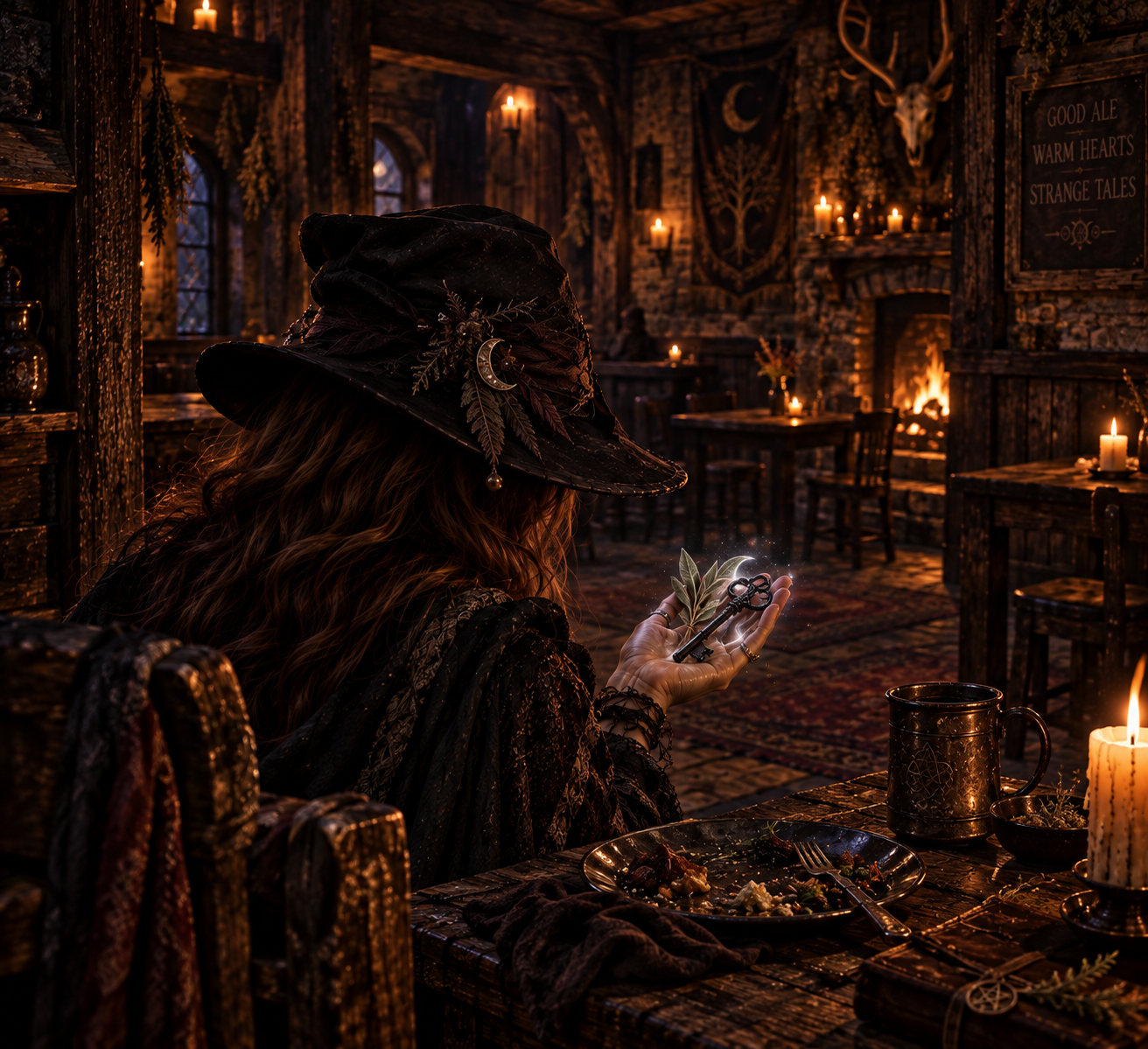
Behind it was a narrow hollow in the wall, untouched by dust, and resting inside was an old black iron key entwined with a dried sprig of sage.
For the briefest moment, the key seemed to catch the moonlight. Not shine. Not sparkle.
Breathe.
A strange warmth traveled through her fingertips when she touched it. Then the glow vanished.
She quickly replaced the board and slipped the key and sage into the small leather pouch at her belt.
She did not know who had hidden it. She did not know what it opened, and she certainly did not understand why, sitting in the darkest corner of an old roadside tavern, it had called to her.
The Wayward Witch looked toward the dark windows. Outside, the wind whispered through the forest. Somewhere among those trees stood a cottage, and somewhere inside that cottage was a woman the tavern keeper had called the Green Witch.
The Wayward Witch closed her hand around the leather pouch and felt the iron key stir faintly within. Salem was still several days away, but the road to Salem, she was beginning to understand, was not meant to be traveled quickly.
Something was calling her into those woods.
And every instinct told her there were discoveries waiting along the way—things she was meant to find, gather, and carry with her.
Whatever awaited her in Salem would have to wait.
First, she must follow the forest.
Chapter III-The Green Witch
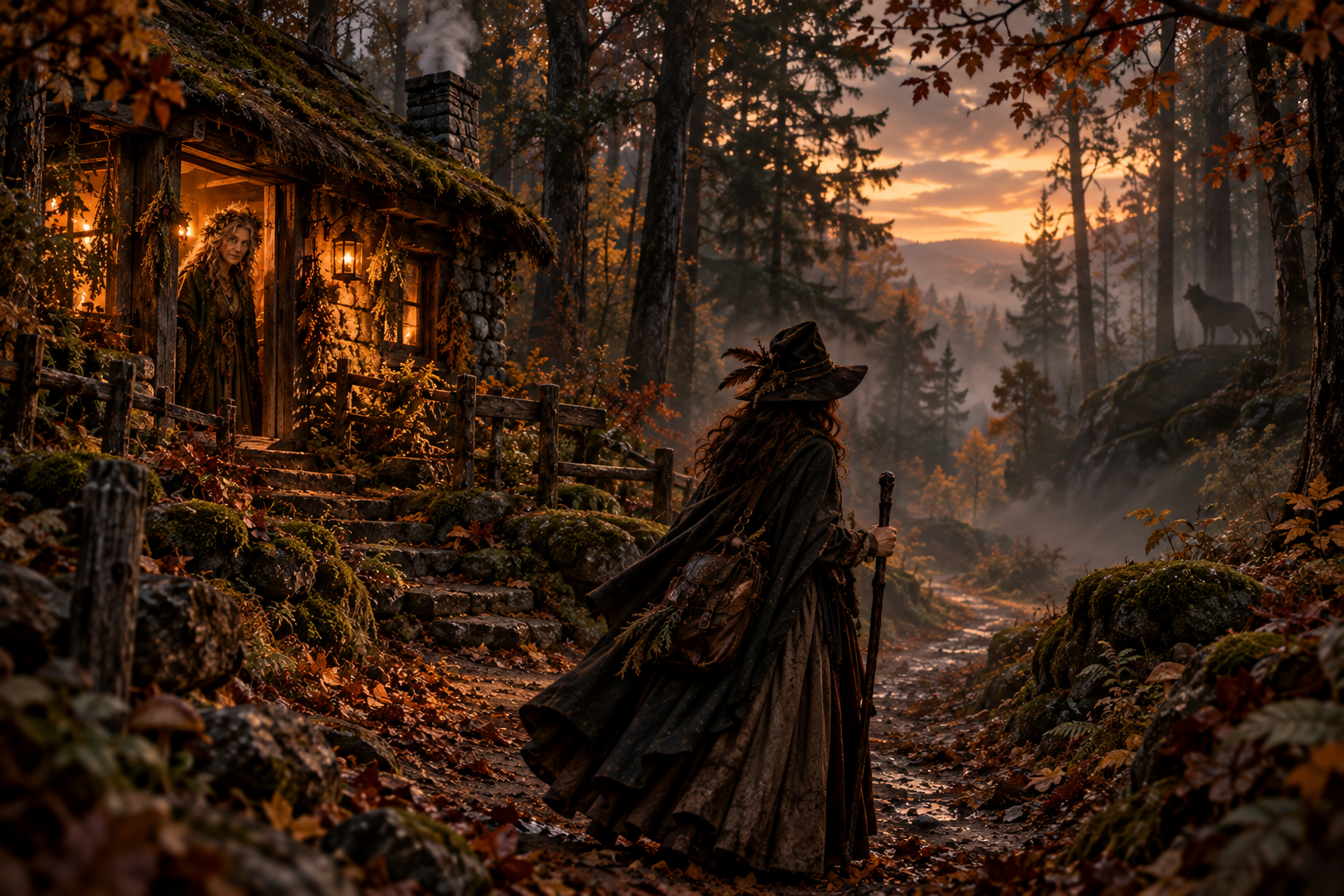
The forest swallowed the road behind her and by midday, the Wayward Witch could no longer hear the creak of wagon wheels or the distant voices of travelers. Only the whisper of wind through the changing leaves remained. The black iron key she had discovered behind the loose tavern board rested heavily in her pocket, still bound with its strange sprig of sage. She had no map to guide her, yet somehow, she knew where to walk. The deeper she traveled, the stranger the forest became. Ferns remained impossibly green beneath trees already touched by autumn. Mushrooms crowded the roots of ancient oaks, and the scent of rosemary, damp earth and woodsmoke drifted through the trees where no chimney could be seen.
Then she found it.
A small cottage stood in a clearing, nearly hidden beneath moss, ivy and twisting vines. Bundles of herbs hung beneath its eaves. Smoke curled lazily from a crooked stone chimney, and beside the door grew plants the Wayward Witch didn't recognize. Before she could knock, the door opened. An old woman stood there dressed in deep forest green, her silver hair was braided tightly against her head, and a sprig of dried rosemary was tucked above one ear. She was small and straight-backed, with hands knotted by age but steady as roots. Her eyes were a clear, unsettling green.
“You took your time,” she said.
The Wayward Witch froze. The old woman studied her from boots to brow, then reached out and brushed a leaf from the traveler’s shoulder. Her fingers were cool.
“You have been followed,” she murmured.
The Wayward Witch glanced over her shoulder. The forest stood silent behind her.
“By whom?”
The Green Witch’s mouth curved faintly.
“If you do not know, it is best not to ask.”
She stepped aside.
“Come inside. You are hungry.”
There were questions the Wayward Witch should have asked. Instead, she followed. The cottage was warm and smelled of sage, roasted vegetables, sweet corn and something savory cooking over the fire. The Green Witch placed a steaming plate before her, then sat opposite without touching her own food. She watched the Wayward Witch eat with an expression that was neither kindness nor suspicion, but something older than both.
“You knew I was coming,” the Wayward Witch said at last.
The old woman lifted her spoon, stirred the empty bowl before her, and set it down again.
“I knew someone was coming, that is not the same thing.”
“No,” she agreed. “It is more useful.”
The Wayward Witch lowered her spoon.
The Green Witch’s gaze flicked to the black iron key beneath the traveler’s coat, as though she could see through the fabric.
“Where did you find it?”
“Behind a loose board in a tavern.”
“Did it call to you?”
The Wayward Witch hesitated.
“It felt warm and shined like the moon.”
The old woman’s fingers tightened once around the edge of the table. Then she released it.
“Keys are rarely warm without reason.”
Only when the fire had burned low did the old woman rise. She crossed the room and pressed one palm against the floorboards. For a moment, nothing happened. Then a narrow board lifted beneath her hand with a soft wooden sigh. From beneath it, she withdrew a worn leather satchel.
“This belongs to you now.”
The Wayward Witch did not reach for it immediately.
“What is it?”
“Something that has been waiting.”
“For me?”
The Green Witch held the satchel out. Her arm did not tremble.
“For whoever was willing to carry it.”
Inside was a book. Its leather cover was aged and scarred, marked by shallow lines that might have been scratches—or writing worn away by time. Yet it was strangely warm beneath the Wayward Witch’s fingers. She opened it. Every page was blank. She turned another. Nothing. The Green Witch watched her over the rim of her cup.
“Do not be so certain there is nothing written there.”
“There is nothing here.”
“Not yet.”
The Wayward Witch looked up. The old woman leaned closer. Firelight moved across her face, catching in the fine lines around her eyes.
“The book does not tell its story before it has been lived,” she said. “Carry it. Watch it. And when the world behaves strangely…”
Her eyes fell upon the black iron key hanging from the Wayward Witch’s belt.
“…open it.”
The Wayward Witch closed the book.
“What will happen?”
The Green Witch reached across the table and tapped the cover once with her forefinger.
“That depends on what has already happened.”
A chill moved through the Wayward Witch despite the warmth of the fire. The old woman withdrew her hand and looked toward the dark window.
“Do not mistake silence for safety,” she said. “The forest is quietest when it is listening.”
Before sunrise, the Wayward Witch continued north with the satchel across her shoulder and the mysterious book tucked safely inside. Salem remained several days away, and there were still roads she intended to follow before reaching Massachusetts.
At the edge of the clearing, she turned back. The Green Witch stood in the cottage doorway, one hand resting against the frame. She had not come out to say goodbye.
“Will I see you again?” the Wayward Witch called.
The old woman’s expression softened, though only for an instant.
“You will see what you are meant to see.”
Then she closed the door. By afternoon, the road disappeared beneath the trees. She had wandered farther into the wilderness than intended when she heard something moving behind her. She stopped. The sound stopped. She walked again. So did it. Finally, she turned, and saw an enormous Irish Wolfhound standing between the trees. His coat was rough and dark, his body lean from the wild, and his eyes held the peculiar expression of a creature that seemed to know far more than he should. One ear was torn near the tip. A pale scar crossed his muzzle.
“Go home,” she told him.
The hound sat.
“I have nothing for you.”
He continued staring.
She shook her head and walked on. For nearly an hour, he followed her. Then suddenly, he vanished. The forest grew darker, and hunger began gnawing at her belly. She had just begun searching for somewhere to make camp when the brush rustled once more. The Wolfhound emerged. This time, he carried a pheasant gently between his jaws. He crossed the clearing and placed it at her feet. The Wayward Witch stared at the bird. Then at the hound.
“You brought me supper?”
His great tail struck the leaves once.
She laughed—the first true laugh the lonely road had taken from her in days.
“Very well. You may stay.”
She cleaned the pheasant and set it over the fire while the Wolfhound watched patiently from the edge of the clearing. As the meat roasted, she gathered what little she had left in her pack: a handful of flour, a small onion, a few herbs and enough water to make a simple dough. The hound lifted his head when the scent changed.
“You have to wait,” she told him. “Good things take time.”
She stirred the flour and water together, pinched off small pieces of dough and dropped them into the simmering pot with the pheasant, herbs and vegetables. Soon the clearing filled with the warm, comforting smell of pheasant and dumplings. The Wolfhound moved closer, his great paws silent against the leaves. When the meal was ready, she filled a wooden bowl for herself and placed another portion on a flat stone before him. He waited until she took the first bite. Then he lowered his head and ate. For a while, neither of them made a sound. They simply shared the meal beside the fire—the Wayward Witch with her bowl balanced in her hands, and the great hound eating carefully from the stone. The dumplings were soft and warm, and the broth settled pleasantly in her empty stomach. She glanced at her companion and found him watching her between bites.
“You are very particular for a stray,” she said.
His tail brushed the leaves. She smiled and offered him the last dumpling from her bowl. He accepted it gently from her fingers, his teeth never touching her skin. That evening, the two of them rested beside the small fire. The Wolfhound slept close enough that his warmth reached her through the blanket. Once, in the middle of the night, he lifted his head and stared into the trees. The Wayward Witch woke at the movement.
“What is it?” she whispered.
The hound did not look at her. His ears remained fixed toward the darkness. After a moment, he lowered his head again. She watched him for a long while before sleep returned. For the first time since beginning her journey, the Wayward Witch did not feel entirely alone. Across the fire lay the leather satchel. Inside it, unseen by either traveler, something was happening. Upon the first blank page of the book, a thin line of black ink slowly appeared.
Not a sentence. Not yet. Only the faint outline…
of a key.
Chapter IV: Where the Old Blood Stirs
The forest had changed. She could not say when it happened. Perhaps sometime after the Green Witch's cottage disappeared behind the trees. Perhaps when the last curl of chimney smoke faded into the evening sky. Or perhaps the forest had always been this way, and she had only just learned how to listen. But something was different. The Wayward Witch pulled her cloak tighter around her shoulders and continued along the narrow path. Beside her walked the great wolfhound. The name had come to her sometime before dawn. She had awakened beside the dying embers of their small fire and found the hound sitting at the edge of the clearing, staring into the darkness. His enormous silhouette was perfectly still, silvered by the last of the moonlight.
“Arawn,” (AH-ROWN, like clown) she whispered.
The hound turned his head and met her gaze with turned up ears.
She frowned.
“Arawn.”
She did not know why she had spoken it. The name belonged to an old story—or perhaps a dream—buried somewhere beyond the reach of her memory. Something about another world. A shadowed realm beyond the mortal one, and a keeper who walked its boundaries with great hounds at his side. She could almost hear a woman's voice telling the tale beside a fire.
"There are creatures who guard the places between worlds, " the forgotten voice seemed to whisper. And sometimes, when the veil grows thin, they find those who have wandered too close."
The memory vanished before she could catch hold of it. Yet the name remained. Arawn. The wolfhound rose. Slowly, he crossed the clearing and rested his great head against her shoulder. Something deep inside her chest tightened. She buried her fingers in the coarse fur along his neck.
“Then Arawn you shall be.”
His eyes closed beneath her touch as though she had not given him a name at all. As though she had simply remembered it, and that thought unsettled her more than she cared to admit. Now he followed beside her as though he had been doing so for years.The leather satchel given to her by the Green Witch hung across her body. Inside rested the strange book with its empty pages, and tucked safely beside it was the black iron key she had discovered behind the loose board in the tavern wall.
Three things she had not possessed when her journey began. A key. A book. And a hound.
She was beginning to suspect that none of them had found her by accident.
By late afternoon, the forest grew unnaturally quiet. No birds called overhead. No squirrels rustled through the leaves. Even the wind seemed unwilling to disturb the trees. Arawn stopped. His ears lifted.
“What is it?”
The hound stared into the woods. Then she smelled it. Woodsmoke. Not the heavy smoke of a village chimney. Something sweeter. Oak. Apples. Warm bread.
And beneath it all, the unmistakable richness of something simmering slowly over a fire. Her empty stomach betrayed her with a growl. Arawn stepped from the path.
“Arawn.”
He looked back at her briefly but was determined to continue ahead. She sighed.
“I suppose we're doing this again," as she followed behind.
They walked until the trees opened into a tiny clearing she was certain had not been there a moment before. A crooked table stood beneath an ancient oak. Lanterns hung from its branches, though she could see no flame inside them. Their light seemed to come from the glass itself. At the table sat a man. Or something very much resembling one. His hair was the color of autumn bark, woven with tiny braids and bits of dried moss. His clothing was made of rough wool, leather and deep green cloth, and his face seemed both young and impossibly old. He was slicing an apple. He did not look up when she entered the clearing. Instead, he cut another thin slice from the fruit.
“You took your time.”
The Wayward Witch stopped. Arawn moved immediately in front of her. The stranger still did not look up.
“You were expecting me?” she asked.
That earned a quiet laugh.
“I was expecting something.”
He finally lifted his eyes. They were golden. Not brown. Not amber. Gold.
“I've felt it moving through these woods for days,” he continued. “A stirring where there should have been none. Old things becoming restless. Paths changing direction.”
His gaze settled upon her.
“But no. I did not know what would eventually walk into my clearing.”
Then he noticed Arawn. The knife stopped against the apple. For the first time, genuine surprise crossed his face.
“Well now.”
His golden eyes remained fixed upon the great wolfhound.
“That makes this considerably more interesting.”
Arawn answered with a low growl. The stranger's mouth curved into an amused smile.
“Yes,” he murmured. “I thought you might say that.”
The Witch rested a hand against Arawn's back.
“What exactly is so interesting about my dog?”
The elf's eyebrows lifted.
“Your dog?”
Arawn growled again.
The elf chuckled.
“My apologies.”
He looked directly at the hound.
“Clearly I have offended you both.”
The Witch was no longer amused.
“Who are you?”, the elf asked as he returned his attention to her.
“That depends entirely upon who is asking. Just a traveler.”
“A traveler,” he repeated thoughtfully. “That tells me what you're doing. Not who you are.”
She frowned.
“Then I'm a woman trying to reach Salem.”
The change in him was subtle. His smile faded.
“Salem.”
“Yes.”
He studied her again. Not with recognition, but with curiosity.
“And what draws you there?”
“I don't know.” she sighed.
The elf tilted his head.
“You travel all this way toward a place and don't know why?”
“I know that I need to reach it.” she appeared frustrated.
“Need.”, he chided
He seemed interested in the word.
“Yes.”
“But you don't know why.”
“No.” she mused.
His gaze drifted briefly toward the satchel hanging against her hip. Then toward Arawn. Finally back to her. The smile returned. Smaller this time.
“Interesting.”
“You keep saying that.”
“Because you keep becoming more so.”
She folded her arms.
“You've felt something coming through your woods. I arrive, and apparently my hound interests you. You know enough about Salem for its name to wipe the smile from your face.”
She took a step closer.
“So perhaps you could stop speaking in riddles and tell me what you know.”
For a moment, the elf simply regarded her. Then he placed his knife carefully beside the half-cut apple.
“I know the woods have been unsettled.”
He nodded toward the trees.
“I know something old has begun moving again.”
His eyes shifted toward Arawn.
“And I know creatures such as your companion do not simply wander out of the forest and attach themselves to passing travelers.”
Her hand stilled against Arawn's fur.
“What do you mean, creatures such as him?”
But the elf had already reached for another apple.
“Now that,” he said, “is a much more interesting question.”
“You haven't answered it.”
“No.”
“Do you ever answer anything?”
“When the answer belongs to me.”
Her irritation showed.
“And when it doesn't?”
His golden eyes met hers.
“I wait for the person carrying it to discover it for themselves.”
Something about those words unsettled her. The elf gestured toward the empty chair across from him.
“Sit.”
She didn't move.
“Why?”
“Because whatever has been disturbing my woods appears to have arrived with you.”
He glanced toward Arawn.
“Or perhaps beside you.”
Then his attention returned to her.
“But I still don't know what it is.”
There was something strangely sincere in that admission. For the first time, she realized he wasn't simply withholding answers. Some of them he genuinely did not have.
“Then why invite me to stay?”
The elf smiled.
“Because you're hungry.”
Her stomach chose that exact moment to betray her.
The elf's smile widened.
“And because I have a feeling that before this meal is finished, Wayward One, we may both know considerably more than we do now.”
She glanced down at Arawn. The wolfhound stared at the laden table.
“Well,” she murmured, “at least one of us trusts him.”
Arawn stepped toward the food. The elf laughed. The Wayward Witch hesitated, then followed.
He invited her to sit. Against every sensible instinct she possessed, she did. Perhaps hunger persuaded her. Perhaps exhaustion, or perhaps some deeper instinct understood that this meeting had been waiting for her. The table before them seemed almost too generous for such a lonely place. Thick sandwiches rested upon a worn wooden board, piled high with warm corned beef between dark slices of marbled pumpernickel and rye. Melted cheese spilled over their edges, and beside them sat crisp kettle-cooked potatoes still warm from the fire. A crock of hearty potato and leek soup steamed between them, thick and fragrant with herbs. Warm German pretzels were piled into a rough-hewn basket, their dark crusts shining in the lantern light. Beside them sat a small earthen bowl of warm beer cheese for dipping. At the center of the table rested another wooden board. Wedges of cheese. Dried fruits. Autumn apples. Nuts and rustic little accompaniments gathered from forest, orchard and pantry. It was the sort of meal meant for travelers. Food meant to warm cold hands, fill an empty stomach and make a weary person linger beside the fire longer than intended. The wood elf poured something warm into a wooden cup and slid it toward her. She hesitated.
“If I intended to poison you,” he said, “you would never have found the clearing.”
Fair enough. She drank. Warmth spread immediately through her chest. Arawn sat close beside her. She tore away a piece of corned beef and offered it to him. The great hound accepted it with surprising delicacy. The elf watched.
“You have fed him before.”
“He found me hungry. I suppose we've been sharing meals ever since.”
The elf's golden eyes remained upon Arawn.
“Found you?”
“Yes.”
A faint smile touched his mouth.
“Is that what you believe?”
She lowered her food.
“What is that supposed to mean?”
But the elf merely reached for an apple.
“Eat. The road ahead will ask enough questions of you.”
For a little while they did just that. They ate. The Wayward Witch dipped a warm piece of pretzel into the rich beer cheese and followed it with a spoonful of potato-leek soup. For the first time in days, she felt warm. Safe, even, and perhaps that was why she allowed herself to relax. Perhaps that was why she didn't notice the elf watching the satchel. Until he finally spoke.
“Where did you get that?”
“A woman in the forest.”
“A woman?”
“The Green Witch.”
His expression changed, only slightly, but she noticed.
“She gave you the book?”
Her hand moved instinctively toward the satchel.
“How do you know there's a book inside?”
The elf did not answer. Instead, he reached across the table for the dark bread. Without thinking, she did the same. Her sleeve slipped backward. The elf stopped. His hand remained suspended above the table. For the first time since she had entered the clearing, every trace of amusement vanished from his face. His golden eyes were fixed upon her hand. Upon the strange mark near her thumb. She quickly pulled her sleeve down.
Too late. The elf slowly lowered his hand.
“Show me.”
“No.”
“Your hand.”, he clarified.
“I heard you.”, she stammered.
Something moved behind his golden eyes. Not curiosity. Recognition. And beneath it—fear.
The Wayward Witch pushed herself away from the table. Arawn immediately rose beside her.
“I think we should leave.”
The elf stood as well.
“Where did you get that mark?”
“I have always had it.”
“No.”, he interjected
His answer came so quickly that she froze.
“No?”
“That mark is not something one simply has.”
She stared at him.
“What is it then?”
The elf looked toward the surrounding trees as though suddenly concerned that they were no longer alone. When he spoke again, his voice was lower.
“Show it to me.”
“Tell me what it is.”
“Show me, and perhaps I can.”
For several moments neither moved. Then, reluctantly, she extended her hand. The elf did not touch her. Instead he leaned closer. The mark was faint—an odd collection of delicate lines beginning near the base of her thumb and disappearing toward her palm. She had carried it for as long as she could remember. Sometimes it resembled the branches of a winter tree, other times a knot. Tonight, beneath the strange lantern light, it looked almost like both. The elf inhaled sharply. Then he whispered a word she did not understand.
“What did you call me?”
His eyes lifted to hers.
“I did not call you anything.”
“Then what did you say?”
His gaze returned to the mark.
“A name that has not been spoken in these woods for many years.”
“Whose name?”
He said nothing.
Her patience broke.
“Whose?”
The lanterns above them flickered. Arawn gave a low growl. The elf looked at him. Then back at her.
“Your family's.”
The world seemed suddenly very quiet.
“My family?”
The elf's face hardened, as though he regretted the words the instant they left him.
“What do you know about them?”
“Less than I once did.”
“That isn't an answer.”, she stated with a stern tone.
“It is the only one I can safely give.” he empathized.
“Safely?”
She pulled her hand back.
“For whom?”
The elf's golden eyes settled upon her.
“For you.”
A coldness crept through her. She looked down at the mark.
“All my life I thought this was nothing more than something I was born with. Why are you afraid of it?” she asked.
“I am not afraid of the mark.” His eyes rose to hers.
“I am afraid of what it means that you still carry it.”
Arawn stood. The hair along his spine lifted. The Wayward Witch felt suddenly exposed.
“What does that mean?”
The elf slowly circled the table.
“There were families once whose knowledge was passed not through books, nor schools, nor churches.”
He glanced toward her satchel.
“It passed through blood.”
She said nothing.
“Herbs. Healing. The old ways of the woods. Things whispered long before men decided which kinds of knowledge were permitted and which should be feared.”
He looked again at her hand.
“Most hid what they were.”
“And mine?”
His expression darkened.
“Yours tried.”
A strange pressure built behind her ribs.
“From whom?”
The elf did not answer.
“From whom?”
Still nothing.
She stepped toward him.
“What happened to them?”
His golden eyes met hers.
“I don't know all of it.”
“But you know something.”
“Yes.”
“Then tell me.”
He hesitated.
“Your family disappeared.”
Her breath caught.
“When?”
“Long ago.”
“That tells me nothing.”
“It tells you what you need to know tonight.”
“No. It tells me what you have decided I should know.”
Something flashed across his face. Approval, perhaps 0r sadness.
“You sound like her.”
The Wayward Witch went still.
“Like who?”
The elf realized his mistake.
“Who?”
He turned away.
She grabbed his arm.
“Who do I sound like?” she pleaded.
The moment her marked hand touched him.....the world disappeared.
A woman's hands. Grinding herbs beneath a stone. Rosemary. Sage. Something bitter she could not name. A great hearth burned nearby. Someone was laughing. A child was laughing. She was laughing, then...A man's voice.
Keep her away from the window.
Another voice. Closer. Urgent.
They know.
The room changed. Running feet. A door slamming. Smoke. A woman dropped to her knees before her. Chestnut hair surrounded a face that refused to remain clear. But this time the Wayward Witch saw her eyes. Her own eyes. The woman seized her small hand. The mark was there. But there was something else. The woman bore the same mark. Larger. Darker. Complete. Her mother pressed their palms together.
Listen to me.
The child's crying filled the room.
You must remember.
“I don't understand.”
Her own voice. Young. Terrified. The woman touched her forehead.
You will.
Something crashed downstairs. The woman looked toward the door. Fear entered her face. Then she pulled the child close.
Never let them see the mark.
Smoke swallowed everything. But before the vision disappeared, another image broke through. A black iron key. Her mother's hand closing around it. And somewhere nearby....a hound was howling.
The Wayward Witch tore her hand away. She stumbled backward. Arawn caught her before she fell, pressing his enormous body against her legs. She could barely breathe. The elf had stumbled too. He stared at her.
“What did you do to me?”, she said breathless.
“Nothing.”, the elf stated gripping his temples.
“You showed me that.”, she exclaimed.
“No. I did not!" For the first time, the wood elf looked genuinely frightened.
She looked down at her trembling hand. The mark seemed darker now. Only slightly. But enough.
“That memory belongs to you.” he stated.
“My mother...”
The word came slowly. She looked at him.
“She had the mark.”
The elf said nothing.
“She had the same mark.” she repeated.
Still nothing.
“You knew her.”
His jaw tightened.
“You knew her.”
“I knew of her.”
“That is not what you almost said.”
He looked away.
“You said I sounded like her.”
Silence.
The Wayward Witch stepped toward him.
“Was that my mother?”
“Yes.”
The answer was barely audible. Something inside her broke open. Not grief exactly. Grief required memories. This was worse. It was mourning someone she had only just remembered existed.
“What was her name?”
The elf closed his eyes.
When he opened them again, there was sorrow there.
“That is one name I will not give you.”
“Why?”
“Because names have power.”
“I am tired of hearing about power!”
Her voice echoed through the clearing.
The lanterns overhead flared. The elf looked up sharply. So did she. For one impossible moment every lantern burned with the same pale light as the mark upon her hand. Then they dimmed. The elf stared at her. The Wayward Witch slowly lowered her hand.
“What just happened?”
He didn't answer.
“What happened?”
“You are getting too close.”
“To Salem?”
His eyes met hers.
“No.”
A chill moved through her.
“To remembering.”
The words struck harder than she expected. She looked toward Arawn. The hound was staring at her hand.
“You looked at him strangely when I arrived.”
The elf remained silent.
“And in the memory there was a hound.”
“That proves nothing.”
“You asked whether I truly believed Arawn found me.”
His expression tightened.
“What is he?”
At the sound of his name, Arawn looked toward the elf. For several long seconds the two regarded one another. Then the elf spoke quietly.
“Some creatures belong to men.”
His eyes remained upon the wolfhound.
“Some belong to the forest.”
Arawn's ears lifted.
“And some belong to neither.”
The Wayward Witch felt the hairs rise along her arms.
“What does that mean?”
“It means you should stop asking whether the hound found you.”
The elf looked at her.
“And begin asking how long he has been looking.”
Her eyes moved to Arawn. The great wolfhound simply stared back. She suddenly remembered the forgotten voice from that morning.
There are creatures who guard the places between worlds.
“Arawn.”
His tail moved once against the earth. She swallowed. Then another thought struck her. She turned back to the elf.
“The key.”
She reached beneath her cloak and pulled out the black iron key. The elf's reaction was immediate. He stepped backward.
“You have it.”
She stared at him.
“You've seen this before.”
“No.”
“You're lying.”
“I have never seen that key.”
“But you know what it is.”
The elf looked from the key to her marked hand. Then to Arawn. His face had lost all color.
“You truly don't know.”
“No.”
He stepped farther away. The lanterns began flickering again.
“You should never have been able to find that key.”
“But I did.”
“And the book?”
“The Green Witch gave it to me.”
“The book should not have opened for you.”
“It hasn't. The pages are blank.”
The elf slowly shook his head.
“Not for much longer.”
She grabbed the satchel.
“Why?”
His gaze settled upon her.
“Because the book was never empty.”
She frowned.
“I've seen the pages.”
“Blank and empty are not the same thing.”
Her anger faltered.
“What does that mean?”
“It was waiting.”
“For what?”
The elf's eyes dropped to the mark.
“For you to get close enough.”
“Close enough to what?”
He turned toward the east.
Toward Salem. Then he said something that chilled her more deeply than anything she had heard since beginning her journey.
“You have mistaken this journey for a search, Wayward One.”
The forest seemed to lean closer.
“You are not searching for Salem.”
His golden eyes met hers.
“Salem has been calling you home.”
She left before darkness completely swallowed the woods. The elf did not try to stop her. But as she reached the edge of the clearing, he called after her.
“When you see the first lights of Salem, do not touch the key.”
She turned.
“Why?”
For a long moment he said nothing. Then:
“Because something there remembers you.”
The clearing vanished behind her. No fading. No mist. One moment it existed. The next there were only trees. She stood staring. Arawn nudged her hand.
“We're getting very good at finding strange people,” she muttered.
The wolfhound sneezed. Despite herself, she laughed. It was the last time she would laugh that night.
Hours passed. The moon climbed. And with every mile, the black iron key grew warmer inside her cloak. The mark upon her hand began to ache. Then burn, and somewhere inside the leather satchel...something moved. She stopped. Arawn growled. Slowly, she opened the satchel. The book was trembling. She pulled it free. The pages were no longer blank. Ink crawled across them. Not written by any hand. Words appeared and disappeared too quickly for her to read. Names. Dates. Symbols. Drawings of plants. A house. A tree, and then....a woman's face. The same woman from her memory.
“Mother?”
The ink vanished. The book slammed shut. Arawn barked toward the road ahead. She looked up. The trees were thinning. Beyond them lay a ridge. And beyond the ridge—lights. She climbed. Her legs were trembling by the time she reached the top. Then she saw it.
Salem.
For weeks she had imagined this moment. She had imagined relief. Triumph. Perhaps even fear. She had never imagined recognition. Because as she stared down upon the distant settlement, one impossible thought entered her mind.
I know this place.
Her hand began to burn. She cried out. The mark near her thumb glowed faintly beneath her skin. Arawn began growling. Not toward Salem. Toward her. No. Not at her. At something around her. The air changed. The warning of the wood elf rushed back into her mind.
When you see the first lights of Salem, do not touch the key.
The key burned against her side. Instinct overwhelmed reason. She reached inside her cloak. Her fingers closed around the black iron.
“No!”
The shout came from somewhere behind her. Or perhaps inside her. Too late. She pulled the key free. The mark upon her hand erupted with light. Wind exploded across the ridge. Her cloak whipped behind her. Trees bent. Leaves spiraled upward into the night.
Arawn threw back his head and howled. And far below—one by one—every candle burning in the windows of Salem went dark. The entire settlement disappeared into blackness. The Wayward Witch stared. Her heart stopped. Then the satchel tore open.
The book flew into the air. Its pages whipped violently beneath the moon until suddenly— they stopped. One page. One sentence. Ink spread slowly across the parchment. She stepped closer. And read.
THE LAST DAUGHTER HAS RETURNED.
Her breath caught. Then....
BOOOONG.
A bell rang somewhere in Salem. Arawn moved against her side.
BOOOONG.
Another bell answered. Then another. Until bells rang throughout the darkness below. But even from the ridge she could see the bell ropes hanging perfectly still. No hands pulled them. No wind moved them. Yet Salem rang. The Wayward Witch looked down at her glowing hand. For the first time in her life, she did not feel the magic surrounding her. She felt it inside her. And somewhere in the darkness below, something awakened. Something that had been waiting a very long time. The black iron key turned in her hand. By itself.
Click.
As though somewhere in Salem— a lock had just opened.
Chapter V: The Last Daughter
Salem, Massachusetts — 1692
Click.
The sound was impossibly small, yet somehow she knew Salem had heard it. The black iron key lay warm against the Wayward Witch’s palm. Only moments before, the bells had cried out without a hand upon their ropes, lanterns had flickered, and the leather-bound book had written the words she could not forget: THE LAST DAUGHTER HAS RETURNED. Then the key had turned in her hand, and somewhere within Salem, something had opened.
Arawn pressed against her leg as they moved deeper into town. Faces disappeared from windows. Doors closed quietly. A woman hurried her children from the street. No one spoke of the bells, and somehow their silence frightened her more than screaming would have. Then a lantern flame bent sharply toward her as she passed beneath it. There was no wind. Another did the same, then another. One by one the flames leaned toward her as though recognizing something she had yet to recognize in herself.
The mark near her thumb burned. Faint silver lines spread across her palm like roots beneath winter soil before disappearing. Something had awakened—not beside her or around her, but inside her.
“You should not do that where they can see,” a voice warned from the shadows.
The Wayward Witch turned. An old woman stood beneath the crooked awning of a small, shuttered tavern. Everyone else in Salem had looked away. This woman stared directly at the mark upon her hand.
“I wondered which of you would come back,” the old woman said.
“Which of who?” the Wayward Witch asked.
The old woman glanced toward the darkened windows around them. “Not here. Come inside. Quickly.”
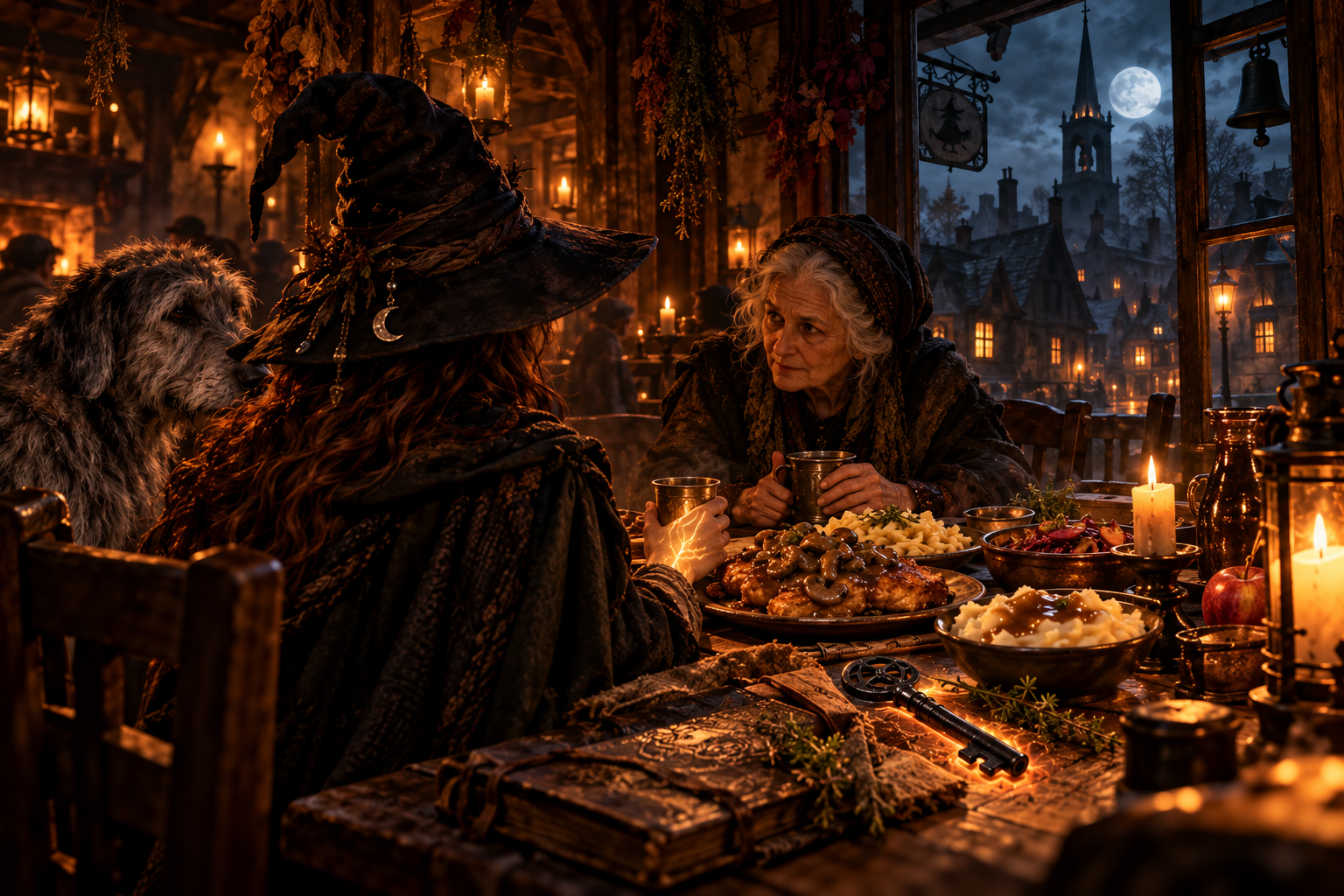
She ushered the Wayward Witch and Arawn through the door and bolted it behind them. Inside, the little tavern was warm and smelled of browned butter, apples and herbs. A fire burned low upon the hearth, and upon a scarred wooden table waited a humble but generous supper.
“You've traveled far,” the old woman said, placing a plate before her. “Questions are better asked on a full stomach.”
The meal was hearty—golden Jägerschnitzel beneath rich brown gravy, mushrooms offered from a separate little crock, tender Spätzle, rustic mashed potatoes with gravy, and warm apple-braised cabbage whose sweetness mingled with the smoke of the hearth.
The Wayward Witch noticed an untouched place setting across from her. “You were expecting someone?”
The old woman gave the faintest smile. “I was expecting you.”
Arawn settled beside the hearth while the Wayward Witch ate. The meal was warm and comforting after the long road north, yet she could not shake the feeling that there was meaning behind the old woman's hospitality.
“What do you call this?” the Wayward Witch asked.
The old woman studied her across the candlelight. “The Witch's Crossing Feast. An old meal for those who have reached the end of one road... and have not yet discovered what waits upon the next.”
The Wayward Witch slowly lowered her fork. “You know what I am.”
“I know what Salem believes you might be,” the old woman replied.
The Wayward Witch pulled the black iron key from her satchel. The old woman's face went pale.
“Where did you get that?” she whispered.
“It found me.”
The old woman shook her head. “No. Things such as that do not find people. They remember them.”
A Salem bell gave a single low toll. Arawn lifted his head.
“You opened something tonight,” the old woman continued, her voice dropping. “And there are those in Salem who have waited a very long time for that lock to turn.”
“What did I open?” the Wayward Witch demanded.
The old woman's eyes moved toward the window.
“That,” she whispered, “is what you must discover before they discover you.”
Before the Wayward Witch could ask who they were, the old woman stood and began extinguishing the candles.
“You must go,” she warned. “And when Salem begins asking who you are, be very careful who hears your answer.”
Later that night, unable to sleep, the Wayward Witch opened the leather-bound book. Its pages remained blank until she touched one.
“You brought me all this way,” she whispered. “Now tell me why.”
Ink crawled across the parchment, forming streets and alleys—a map of Salem. At its center appeared a single black mark, and inside her satchel, the iron key grew hot.
The map led her and Arawn through sleeping streets to an abandoned building. Beneath a broken table she discovered a raised floorboard and almost laughed. Another loose board. Beneath it waited a staircase descending into darkness.
At the bottom stood an ancient door carved with the same symbol marked near her thumb. She placed the iron key into its lock.
It did not fit.
“No,” she whispered.
After everything—the tavern, the Green Witch, the satchel, the Wood Elf and the long road to Salem—it could not end here. Anger rose within her, and the mark began to glow. Without understanding why, she pressed her palm against the door.
Click.
The door opened.
The iron key slipped from her other hand and struck the floor. It had brought her here, but suddenly she understood: the key had never been meant for this door. She was.
Beyond it waited a forgotten chamber filled with dried herbs, dusty bottles and an ancient iron cauldron. Strange symbols covered the walls, each resembling some portion of the mark upon her hand. Then she saw four portraits. Their faces had been violently scratched away—all except the youngest woman.
She had the Wayward Witch’s eyes.
Beneath the portrait was a family name.
She read it.
Every candle in the chamber erupted into flame. Bottles rattled, herbs twisted in wind that did not exist, and the iron cauldron trembled against the stone. The book flew from her satchel, pages turning violently as Arawn backed toward the doorway.
“STOP!” the Wayward Witch cried, throwing out her hand.
Everything stopped.
A single candle flame bent toward her fingers. This time she did not recoil. She concentrated, lifted her hand, and the flame rose with it. She moved her fingers and the flame followed.
For the first time on the long road north, she did not feel magic surrounding her.
She felt it answering her.
The book lay open upon the floor as ink slowly appeared across the page.
ONE HAS AWAKENED.
Then another line formed.
OTHERS WILL FOLLOW.
Arawn turned toward the ceiling and howled. Far above them, one Salem bell began to ring, then another, until every bell in town cried into the darkness.
The Wayward Witch looked at the ruined portraits, the ancient cauldron, the woman who shared her eyes, and finally her own glowing hand.
The bells had announced her arrival once.
This time, she understood.
They were not ringing for her.
They were ringing for what she had awakened.
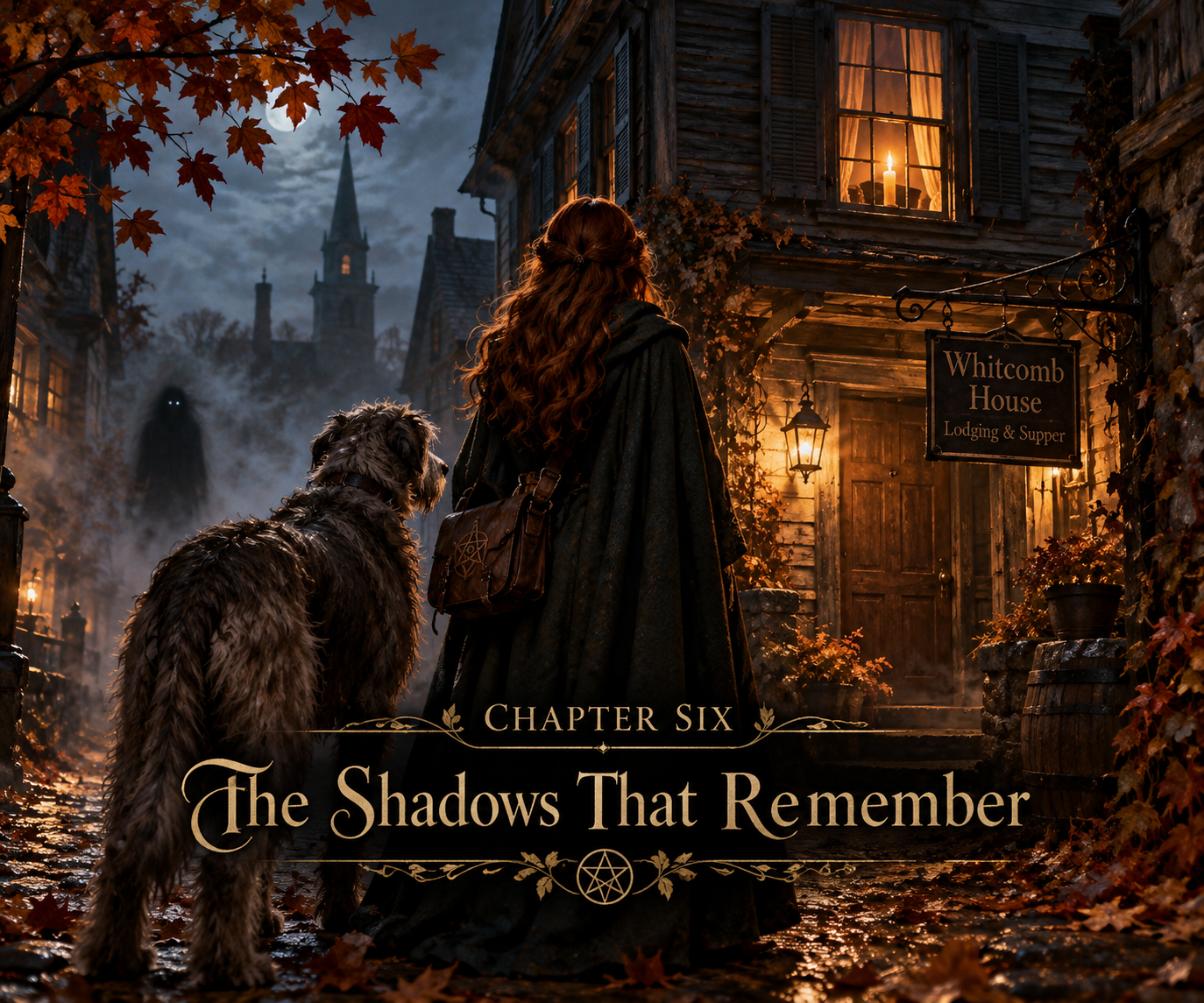
Chapter VI: The Shadows That Remember
Salem, Massachusetts — October, 1692
Some houses remember the families who once filled their rooms. Some secrets survive beneath the ashes of forgotten hearths. And some shadows are not cast by anything living. For the Wayward Witch, the road had finally led her to Salem. But Salem had been waiting for her.
The bells had not stopped ringing. Their mournful voices drifted through the narrow streets of Salem, echoing between crooked rooftops and weathered timbered houses. The sound seemed to follow her even here, deep within the hidden chamber of the old family home, where the strange leather-bound book trembled faintly in her hands.
ONE HAS AWAKENED. OTHERS WILL FOLLOW.
The words remained upon the page. She read them once more, hoping their meaning might somehow change, but the dark lettering offered no explanation. Beside her, Arawn stood motionless, his enormous body positioned between her and the passageway. The great Irish wolfhound had been unusually quiet since they entered the house, though his ears remained pricked and every so often a low rumble stirred deep within his chest.
She looked again at the portraits hanging upon the chamber walls. The faces had been deliberately damaged, their eyes scratched away and names gouged from the wooden frames. Generations of a family someone had wanted the world to forget. Yet one portrait remained nearly untouched. A young woman stood beside a stone hearth, one hand resting upon the shoulder of a little girl. The woman's face was hauntingly familiar, but the child's features had been scraped away.
The Wayward Witch stepped closer. "Who were you?" she whispered.
A cold draft stirred the dust beneath her feet, and the candle flames bent toward the portrait. Arawn suddenly barked, his voice thundering through the chamber. She turned sharply, catching the briefest glimpse of something dark moving along the far wall. It was not a person, nor quite a shadow, but something taller than a man, its edges dissolving into the stone itself. She raised her candle, but the shape had vanished. Only the wall and the old iron fittings remained. Arawn continued staring into the darkness, his hackles raised.
"We have lingered long enough, old friend," she murmured.
She closed the book and tucked it safely into the satchel given to her by the Green Witch. Whatever secrets this place held, she would not uncover them all tonight. As she made her way back through the passage, the bells continued their hollow calling, and for the first time since beginning her long journey north, she felt certain of one thing. She was no longer simply searching for Salem. Something in Salem had begun searching for her.
By the time she emerged into the street, evening had settled over the village. A damp October mist crept between the houses, softening the glow of candles behind shuttered windows. The air smelled of wet leaves, chimney smoke, and the distant salt of the harbor. She pulled her cloak more tightly around her shoulders, remembering the warning she had been given earlier: find a boarding house, seek shelter, and be cautious of those who offered kindness too quickly.
The streets were quieter now. A man hurried past carrying a lantern, refusing to meet her eyes. Two women stood whispering beside a garden wall, their conversation falling silent as she approached. Fear had settled over Salem like a second autumn. It clung to the buildings, to the faces, and even to the church bells.
At the end of a narrow lane, she noticed a small wooden sign swinging gently above a doorway: Whitcomb House — Lodging & Supper. A single candle burned in an upstairs window. There was something about that candle that made her stop. Its flame seemed unusually steady despite the wind pressing against the glass. Arawn approached the door and sat, looking back at her expectantly.
"Well," she said softly, "I suppose you have made the decision for us."
She knocked, and after several moments came the sound of a bolt being drawn. The door opened just enough to reveal an elderly woman holding a brass candlestick. Her silver hair was tucked beneath a linen cap, and her plain brown dress bore the signs of long work. Yet her eyes were sharp, and they studied the stranger with an intensity that made the Wayward Witch uncomfortable.
"Evening," the woman said cautiously. "Are you seeking lodging, child?"
"If you have a room to spare," the Wayward Witch replied. "And perhaps a little supper. We've traveled a considerable distance."
The woman's gaze drifted toward the enormous wolfhound standing patiently beside her. "Well, I suppose there's room enough for the both of you, provided that great beast doesn't intend to eat me out of house and home."
A faint smile crossed the Wayward Witch's face. "He's better mannered than most men I've encountered along the road."
The woman laughed softly, but as the Wayward Witch stepped into the candlelight, her amusement faded. For a moment she stared, her fingers tightening around the edge of the door. "Heaven preserve us," she whispered. "You have her eyes."
The Wayward Witch stopped. "Whose eyes?"
The elderly woman seemed to catch herself. "Oh, pay no mind to an old woman's foolishness. Come inside before the cold finds its way into your bones. I'm Mercy Whitcomb, and there's supper upon the hearth."
Yet as Mercy turned toward the kitchen, she glanced once more at the stranger standing in her doorway. Her expression was no longer one of simple curiosity. It was recognition, and beneath it, something very much like fear.
The warmth of the house struck the Wayward Witch immediately. A generous fire burned in a broad stone hearth, bundles of rosemary, thyme, and sage hung from the rafters, and the scent of roasted garlic, rich tomatoes, browned meat, and freshly baked bread filled the room. A heavy wooden table stood near the kitchen, its surface polished smooth by years of use. Something about the room tugged at her heart, not quite a memory, but a longing she could not explain.
"Have you traveled far?" Mercy asked, setting another log upon the fire.
"Farther than I expected."
"And what brings you to Salem?"
The Wayward Witch hesitated, watching the flames dance against the stone. "I believe I have family here."
Mercy grew very still. "Family?"
"Or perhaps I once did. I've come to learn the truth."
The candle trembled in Mercy's hand. She studied the young woman's face once more, then quickly turned away. "Well, you've come to a troubled place to seek answers, child. Salem is not what it once was."
Arawn wandered toward the hearth and settled himself upon the rug, though his nose remained pointed hopefully toward the kitchen. Mercy watched him for a moment, her expression softening. "That beast looks as though he remembers this house," she murmured.
The Wayward Witch glanced toward her companion. "He's been behaving strangely since we arrived."
"Animals often know things we have forgotten," Mercy replied, then busied herself with supper.
The Wayward Witch watched with fascination as Mercy lifted a heavy baking dish from the oven. Its golden surface bubbled gently, releasing a fragrance unlike anything she had encountered upon her travels. Beneath the browned cheese lay layers of tender pasta, rich meat sauce, and fragrant herbs, all nestled together in a deep earthenware dish.
"What manner of pie is this?" she asked, leaning closer. "I've never seen a crust made in such a fashion."
Mercy laughed. "No pie, child. It is called lasagna. The thin sheets are made with flour and eggs, rolled until they're delicate enough to fold beneath the weight of the sauce. Then we layer them with meat, cheese, and herbs before baking the whole thing until it turns golden."
"Flour and eggs?" the Wayward Witch repeated, marveling as Mercy cut a generous portion. "And all of it baked together?"
"Aye. Every layer lends something to the next. That's the secret of it."
Mercy set the plate before her, and the Wayward Witch took her first bite. The richness of the slow-cooked meat mingled with the soft pasta and creamy cheese, while the herbs offered a warmth that seemed to linger long after she swallowed.
"Oh, Mercy," she whispered, closing her eyes. "I've traveled through villages and forests, shared meals beside strangers' fires, and tasted things I never knew existed. But this..." She smiled. "This is a feast fit for a king."
"Or a weary traveler who has finally found her way home," Mercy replied softly, then turned toward the oven. "And I have something else for you."
She returned carrying a small earthenware crock filled with a warm, creamy mixture, its surface lightly browned and bubbling at the edges. Beside it lay a basket of thick, golden breadsticks brushed with butter and scattered with herbs.
"Roasted garlic, spinach, artichokes, and smoked Gouda," Mercy explained. "A little indulgence for a cold evening."
The Wayward Witch broke one of the breadsticks in half, releasing a cloud of fragrant steam. She dipped it into the warm mixture and tasted it cautiously. Her eyes widened.
"Mercy! What sort of enchantment have you stirred into this?"
The older woman laughed, a genuine, hearty sound that seemed to chase the shadows from the room. "No enchantment, child. Only good ingredients, a patient fire, and a cook who knows when to leave well enough alone."
The Wayward Witch took another bite, smiling in spite of the unease that had followed her since entering Salem. For the first time in many days, she felt something close to peace. Mercy watched her quietly, her own smile fading into an expression of tenderness.
"Your mother loved this dish," she said before she could stop herself.
The Wayward Witch froze, the breadstick halfway to her lips. "My mother?"
Mercy's face changed. She turned quickly toward the hearth, busying herself with the kettle. "I only meant that there are some recipes that pass from one generation to the next. Food has a way of carrying memories, even when the people who made it are long gone."
The Wayward Witch looked down at her plate. The strange familiarity she had felt upon entering the house returned, stronger now. Somewhere beyond the reach of her memory, she could almost hear a woman laughing in a warm kitchen. For a fleeting instant, she smelled rosemary and fresh bread, and heard a voice calling her little bird. Then the feeling vanished.
From the darkened hallway, Arawn gave a low growl. Mercy looked toward the shadows, and the warmth of the room seemed to fade.
Later, Mercy showed her to a small upstairs chamber overlooking the lane. The room held a narrow bed, a washstand, a wooden chest, and a little writing table beneath the window. A candle burned upon the sill, the same candle she had seen from the street.
"Do you leave it burning every night?" she asked.
Mercy stood in the doorway. "Aye."
"For travelers?"
The older woman looked toward the flame. "For someone who lost the road a long time ago."
"Did they ever return?"
Mercy smiled, but sadness filled her eyes. "Perhaps," she said. "Perhaps they have."
Then she closed the door, leaving the Wayward Witch alone with her thoughts.
The first sound came shortly after midnight. A faint scraping, like fingernails against wood. The Wayward Witch opened her eyes. The room was dark except for the candle upon the sill, and Arawn stood beside the door, motionless, his head lowered and his lips drawn back from his teeth.
"Arawn?" she whispered.
The wolfhound did not turn. Something moved beneath the door. A thin ribbon of darkness stretched across the floorboards, creeping slowly toward the bed. It was not cast by the candle. Indeed, the candle flame seemed to recoil from it.
The Wayward Witch reached for her satchel, feeling the book inside grow strangely warm. She drew it out, and as her fingers touched its leather cover, the shadow stopped moving. Slowly, impossibly, it began to rise from the floor, gathering itself against the wall, tall and indistinct, almost human. Its edges shifted like smoke, yet there was something deliberate in the way it moved. Arawn growled but did not attack.
Then the shape lifted what might have been an arm, not toward her, but toward the window. She turned. Across the lane, beneath the weak light of the moon, a man stood watching the boarding house. He wore a long dark coat and a broad-brimmed hat, his face hidden beneath its shadow.
The Wayward Witch moved closer to the glass, trying to make out his features. When she looked back toward the wall, the strange figure had vanished. The candle burned steadily again, and the book lay open in her hands. Upon its once-blank page, a single sentence had appeared.
Not every shadow comes to harm you.
She stared at the words, then hurried back to the window. The man across the lane was gone, but beneath the old oak tree, the mist continued to move long after the wind had fallen still. For the remainder of the night, she did not sleep.
Morning brought rain. It fell in thin silver threads from a low gray sky, pattering against the roof and gathering in muddy pools along the lane. When the Wayward Witch descended the stairs, Mercy was already kneading dough upon the kitchen table, while Arawn lay beside the hearth, watching the older woman with the solemn attention of a creature expecting breakfast.
"You have won him over," the Wayward Witch said.
Mercy smiled. "That beast has a finer understanding of hospitality than most folk in Salem." She dusted flour from her hands and studied the young woman's face. "Did you sleep?"
"Some."
"Dreams?"
"Something like them."
Mercy nodded, as though she had expected no other answer. After breakfast, she prepared a small parcel wrapped in brown cloth. Inside were dried herbs, a piece of bread, and a little jar of honey.
"I wonder if you might do an errand for me," Mercy said.
"Of course."
"There is a woman who has suffered greatly through these troubles. Her name is Tituba."
The Wayward Witch repeated the unfamiliar name. "Tituba?"
"She was among the first accused when the madness began. She remains imprisoned, and there are few who remember that even the condemned grow hungry." Mercy's voice hardened. "Or that an accusation is not proof."
She placed the parcel in the Wayward Witch's hands. "Take these provisions to the jail. Tell the keeper they are from Widow Whitcomb. If he permits them to be delivered, I would be grateful."
The Wayward Witch hesitated. "Why send me?"
Mercy looked at her for a long moment. "Because there are some people in Salem who ought to meet one another."
Before another question could be asked, Mercy turned back to her bread. "And child?"
"Yes?"
"Keep your gloves upon your hands."
The Wayward Witch frowned. "Why?"
Mercy's expression grew grave. "Because there are men in this town who notice things they have no business noticing."
The jail was a miserable place, its heavy walls seeming to absorb what little daylight reached the narrow windows. The air smelled of damp straw, cold stone, and suffering. Arawn waited outside beneath the shelter of a narrow overhang while the Wayward Witch approached the keeper.
The man accepted Mercy's parcel with reluctance. "That woman has had enough visitors," he muttered.
"I have no wish to trouble her," the Wayward Witch replied. "Only to bring what Widow Whitcomb has sent."
At the mention of Mercy's name, the man's expression softened slightly. After some argument and the exchange of a small coin, he allowed a brief meeting, though he warned her that she was to ask no questions concerning the trials.
She followed him through a narrow passage, her footsteps echoing against the stone. Behind the heavy doors, she heard coughing, murmured prayers, and the occasional sound of someone weeping. At last, the keeper stopped beside a barred opening.
"You have your visitor," he called impatiently. "Make it brief."
A woman sat upon a narrow bench in the dimness beyond. Her clothing was worn, her face drawn by hardship, and her eyes carried the exhaustion of someone who had endured more than any soul should be asked to bear. Yet when she lifted her head, there was nothing vacant in her gaze.
"Who sends you?" the woman asked.
"Widow Mercy Whitcomb. She has sent food and a few comforts."
The woman looked toward the parcel. "Mercy," she murmured. "There are still some in this town who remember kindness."
The keeper passed the parcel through, then withdrew a short distance down the passage.
"My name is Tituba," the woman said. "Though I suppose you have already been told."
"I have."
"And what is your name, child?"
The Wayward Witch hesitated. "I wish I knew."
Tituba's expression changed. For a long moment, neither spoke. Then she leaned forward slightly. "That is a strange answer."
"It is the only honest one I possess."
Tituba studied her face, then her hair, then the satchel resting against her side. Her eyes narrowed, not with suspicion, but with something resembling recognition.
"Where did you get that satchel?"
"It was given to me by a woman I met upon the road."
"What woman?"
"One who knew more about me than she was willing to say."
Tituba's gaze returned to her face. "And you have come to Salem seeking what was taken from you?"
The Wayward Witch felt a chill. "How could you know that?"
Tituba did not answer immediately. Instead, she glanced toward the passage where the keeper stood. "Come closer," she whispered.
The Wayward Witch stepped nearer the bars.
"There are names in this town that ought never be spoken where the walls have ears."
"Do you know who I am?" the Wayward Witch asked.
Tituba studied her for a long moment. "I knew a woman once. A woman who understood that the greatest danger in Salem would not come from those accused of witchcraft, but from those who found advantage in the accusing."
"Who was she?"
"A mother."
The Wayward Witch's breath caught. Tituba continued, her voice scarcely above a whisper. "She had a little daughter. A child with curious eyes and a habit of asking questions no grown person wished to answer."
The Wayward Witch gripped the cold iron bars. "What happened to them?"
Tituba's expression darkened. "That is not a tale for this place."
"Please."
Tituba leaned closer. "Your mother once spoke of bells that would ring when what had been hidden began to awaken."
The Wayward Witch felt the blood drain from her face. The bells. The chamber. The book.
Tituba noticed her reaction. "You have heard them, then."
Before the Wayward Witch could answer, the keeper's footsteps approached.
"Enough," he snapped. "Your time is finished."
Tituba reached through the bars and caught the edge of the young woman's sleeve. "Listen carefully. Do not trust every man who speaks of righteousness. Some use the name of God to conceal the work of their own hands."
The keeper seized the door. Tituba released her sleeve, but her final words followed the Wayward Witch down the passage.
"And child... if the shadows have begun to follow you, do not be so certain they mean you harm."
The Wayward Witch stopped and turned, but the keeper had already stepped between them.
"Out," he ordered.
She left the jail with more questions than she had brought, and a terrible certainty growing within her. Tituba knew something of her past, and whatever that knowledge was, someone had gone to great lengths to bury it.
The rain had stopped when she emerged into the street. Arawn greeted her with a low whine, pressing his great head against her hand. She knelt beside him, grateful for the familiar warmth of his fur.
"Everyone seems to know something of me," she whispered. "Everyone but myself."
Arawn licked her fingers. She smiled faintly. "Aye. I suppose that includes you."
They had scarcely begun walking when a gentleman stepped from beneath the awning of a nearby shop. He was tall and neatly dressed, his dark coat finely tailored and his boots polished despite the muddy streets. Silver threaded his hair at the temples, and his expression was one of practiced warmth.
"Forgive me," he said, removing his hat. "I could not help noticing that you are unfamiliar to our village."
The Wayward Witch stopped. "I have only recently arrived."
"Then allow me to offer a welcome, though I fear Salem has become a poor place for hospitality. My name is Silas Crowe."
Something stirred unpleasantly within her, though she did not know why.
"A pleasure," she replied cautiously.
Crowe's eyes moved briefly toward Arawn. "A magnificent creature. Unusual company for a lady traveling alone."
"He has proven himself more than capable of keeping me safe."
"I do not doubt it." Crowe chuckled, though his gaze lingered upon the wolfhound a moment too long. "And where have your travels brought you from?"
"Many places."
"Ah. A woman of mystery."
"Merely a traveler."
Crowe smiled again. "Then I hope you find what you seek."
She shifted the satchel upon her shoulder, and his eyes followed the movement. For one fleeting instant, the pleasant expression disappeared from his face. He was looking at the leather-bound book, whose worn corner had slipped into view.
"That is an interesting volume," he observed.
The Wayward Witch tucked it farther beneath her cloak. "An old book. Nothing more."
"Old books," Crowe replied softly, "have a curious habit of preserving things best forgotten."
Arawn growled, and Crowe looked down at him. "Your companion appears to dislike me."
"He is cautious of strangers."
"A wise habit in these troubled times." Crowe replaced his hat and stepped aside. "Do give my regards to Widow Whitcomb."
The Wayward Witch froze. "I did not tell you where I was staying."
Crowe's smile did not falter. "Salem is a small place, my dear. Very little escapes notice."
He bowed politely. "Good day."
She watched him walk away, his dark coat disappearing into the crowd. Only when he had vanished did she realize her hands were trembling. Arawn remained beside her, staring after the man, and somewhere in the depths of her satchel, the book had begun to grow warm.
Mercy was waiting when they returned. She stood beside the kitchen window, her hands clasped tightly before her. At the sight of the Wayward Witch, she released a breath that seemed to have been held for hours.
"You were gone a long while."
"The keeper allowed me to speak with Tituba."
Mercy turned sharply. "She spoke to you?"
"Yes."
"What did she say?"
The Wayward Witch hesitated. "She knew something of my mother."
Mercy closed her eyes. For a moment, the only sound was the gentle bubbling of a kettle above the hearth.
Then the Wayward Witch spoke again. "I met a gentleman upon the road. Silas Crowe."
The kettle hissed. Mercy's face went pale. "Crowe?"
"He knew I was staying here."
Mercy crossed the room and shut the curtains. "Did you tell him your name?"
"No."
"Did he see your hand?"
"I don't believe so."
Mercy gripped the edge of the table. "Thank heaven."
The Wayward Witch stepped toward her. "Mercy, what is happening? Everywhere I turn, someone seems to recognize something about me. The house, the portraits, the book, Tituba, and now this man. I cannot continue wandering through riddles while everyone else holds the answers."
Mercy looked at her, and for the first time the older woman's composure broke. "You are right, child. You are right."
She lowered herself into a chair, and the Wayward Witch sat opposite her. For a long while, Mercy said nothing. Then she reached beneath her shawl and withdrew a small silver pendant suspended from a faded blue ribbon. It was shaped like a tiny star enclosed within three curved lines.
The Wayward Witch stared. She had seen that symbol before, carved into the hidden chamber, pressed into the old book's binding, and marked faintly upon the skin near her thumb.
"Where did you get that?" she whispered.
Mercy's eyes filled with tears. "It was given to me many years ago."
"By whom?"
Mercy reached across the table and placed the pendant in her hand. "By a woman who feared she might never see her daughter grow to womanhood."
The Wayward Witch could scarcely breathe. "My mother?"
Mercy nodded. "Aye, child." She reached out and gently took the Wayward Witch's trembling hand. "I knew your mother."
The words seemed to silence the entire house. Even the fire burned quietly. The Wayward Witch stared at Mercy, tears gathering in her eyes.
"Then tell me," she whispered. "Please. Tell me who I am."
Mercy opened her mouth, but before she could speak, Arawn rose from the hearth. His great body stiffened, and a deep, terrible growl filled the room.
Then came a knock at the front door. Three slow, deliberate knocks that echoed through the quiet boarding house.
"Widow Whitcomb?" a familiar voice called from outside.
The Wayward Witch's stomach tightened. She recognized that voice immediately. It belonged to the gentleman who had stopped her outside the jail.
"Silas Crowe," the voice continued pleasantly. "I trust I haven't come at an inconvenient hour."
Mercy gripped the edge of the table. "What does he want here?" she whispered.
"He spoke to me earlier," the Wayward Witch replied. "Outside the jail. He asked where I'd traveled from, and he noticed my book."
Mercy's face drained of color. "He saw the book?"
"I believe so. He seemed particularly interested in it."
Mercy glanced toward the satchel, and something close to terror crossed her face. "Then we have very little time."
Another knock sounded, louder this time.
"Mercy," Crowe called, his voice still warm and courteous, "surely you wouldn't leave an old acquaintance standing in the cold. I merely wish to continue a conversation I began with your young guest this afternoon."
The Wayward Witch looked toward the door. "How did he know I was here?"
Mercy shook her head. "Because he has spent years watching this house. Watching me."
A chill crept along the Wayward Witch's spine. "Why?"
Mercy reached for her hand, pressing the silver pendant firmly into her palm. "Because there was a time when I helped someone escape him. Someone he has never forgiven me for protecting."
The Wayward Witch stared at her. "My mother?"
Mercy's eyes filled with tears, but before she could answer, Crowe spoke again.
"I should hate to involve the constable, Mercy. Particularly when there are so many questions these days about those who offer shelter to strangers."
The threat was unmistakable. Mercy straightened, gathering what courage she could.
"Upstairs, child. Quickly. And whatever happens, you must not let him see the mark upon your hand."
"But I cannot leave you alone with him."
"You must. Your mother entrusted me with something precious once, and I will not fail her a second time."
Arawn moved toward the door, baring his teeth. Mercy glanced at the great wolfhound, then back at the Wayward Witch.
"Take him with you. Keep him quiet if you can."
The Wayward Witch reluctantly obeyed. As she climbed the narrow staircase, something dark shifted along the wall beside her. The shadow she had seen the previous night rose silently from the floorboards, taller than before, its form wavering like smoke above a dying fire. But this time she did not recoil. The shadow turned toward the front door, as though preparing to stand between her and the man waiting beyond it.
She reached her chamber and closed the door, her heart pounding. Arawn settled beside her, his eyes fixed upon the threshold. On the writing table, the leather-bound book began to tremble. Its pages turned slowly at first, then faster, until they stopped upon a sheet of yellowed parchment. Dark letters spread across the page.
THE FIRST HAS BEEN FOUND. THE SECOND HAS COME TO CLAIM HER.
Then, beneath those words, a final warning formed.
The blood remembers. The shadows awaken. And the man below knows what became of the child.
From downstairs came the sound of the bolt being drawn.
"Master Crowe," Mercy greeted him, her voice carefully composed. "What business brings you to my door at such an hour?"
Crowe chuckled softly. "Come now, Mercy. Surely you know why I've come. I had the pleasure of meeting your guest earlier today. A most curious young woman, carrying a most curious book."
There was a long silence. Then Crowe spoke again, his voice lower now, stripped of its earlier warmth.
"Tell me, Mercy. When you looked into her eyes, did you see the resemblance as plainly as I did?"
Upstairs, the Wayward Witch stopped breathing. Mercy said nothing.
Crowe continued. "I thought it impossible at first. After all these years, one learns to accept that certain matters have been settled. Certain families extinguished."
The floorboards creaked beneath his footsteps.
"But then I saw that book," he said. "And I remembered a little girl."
The Wayward Witch gripped the silver pendant, its edges pressing painfully into her palm. Across the chamber, the shadow slowly lifted its head. For the first time, she saw something within its darkness. Two faint points of silver light. Eyes watching her, not with hatred or hunger, but with a sorrow so ancient that it seemed to reach across the years.
Then, from somewhere deep within the walls of Whitcomb House, came a whisper. A woman's voice, soft and familiar, a voice she had heard only in the broken fragments of her dreams.
"Be brave, little bird. You are closer to home than you know."
The candle went out. Downstairs, Crowe's voice became little more than a whisper.
"Tell me, Mercy..."
A dreadful silence followed.
"Does Mara Vale's daughter know what her mother did?"
And somewhere beneath the floorboards, something answered with three slow knocks.
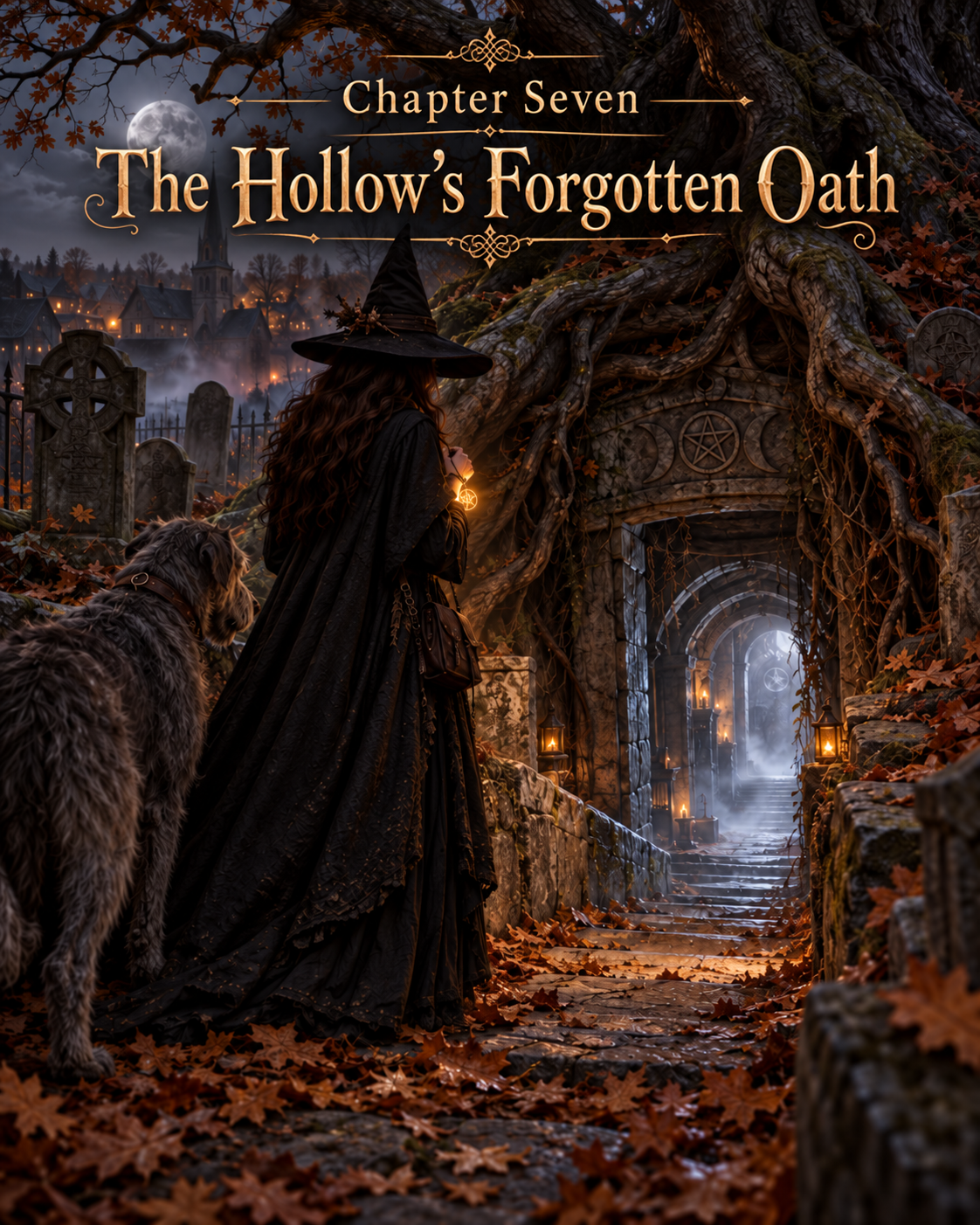
Chapter VII: the Hollow’s Forgotten Oath
The fire crackled softly in Mercy Whitcomb's hearth, but its warmth had done little to ease the tension gathering around the table. Silas Crowe stood near the mantel, his dark eyes fixed upon the Wayward Witch. Arawn remained close to her side, his great gray head raised, watching their visitor with unmistakable suspicion.
“Does Mara Vale's daughter know what her mother did?” Crowe asked.
Mercy went still. The Wayward Witch slowly lowered the leather-bound book in her hands. She had grown accustomed to strangers knowing more about her journey than they should, but hearing her mother's name spoken with such certainty made her blood run cold. “What exactly are you accusing my mother of?” she demanded.
Crowe glanced toward Mercy. “You haven't told her, have you?”
“Mind yourself, Silas,” Mercy warned. “Some histories are not yours to tell.”
“And some histories,” Crowe replied, “have been buried long enough.”
Arawn released a low growl. Crowe's attention shifted toward the great hound. “Still guarding her, I see. Some loyalties survive even death.”
The Wayward Witch felt a chill move through her. “What does that mean?”
But Crowe ignored the question. “Your mother stood in this very house many years ago. She came seeking the same answers you now seek. And before she departed, she left something behind that should never have been forgotten.”
Mercy gripped the back of her chair. “Silas, enough.”
Crowe reached inside his coat and withdrew a folded parchment, its edges darkened by fire. “Then perhaps you should explain this.”
He placed it upon the table. The Wayward Witch carefully unfolded the paper. Three women stood beneath the branches of a leafless tree, their faces deliberately scratched away, much like the portraits she had discovered within her family's hidden chamber. Beneath them were three names.
Mara Vale. Eleanor Whitcomb. Agnes Crowe.
She looked up at Mercy. “Who were these women?”
Mercy's expression changed, and for the first time since the Wayward Witch had entered her home, the widow appeared truly frightened.
“They were the three who made the promise,” she whispered.
“What promise?”
Mercy glanced toward the window, where the gathering darkness pressed against the glass.
“The promise that kept Salem safe.”
Silas gave a bitter laugh. “Safe? Look around you, Mercy. The town has turned upon itself. Neighbors have accused neighbors, innocent souls have been condemned, and fear has made monsters of ordinary men. Tell me, does that sound like a promise kept?”
“Whatever evil men have done here belongs to them,” Mercy answered sharply. “Do not lay their cruelty at Mara's feet.”
The Wayward Witch studied the drawing once more. Something about the three women troubled her, not merely the violence with which their faces had been scratched away, but the familiarity of their arrangement. Three figures beneath a tree, their hands joined in a circle. She had seen that very image before, though she could not remember where.
“Who scratched away their faces?” she asked.
Neither answered.
Crowe finally reached for his coat. “Ask your widow what became of Agnes Crowe. Ask her why Mara Vale fled Salem while others remained to bear the consequences.”
“And what of you?” the Wayward Witch asked. “Why are you so interested in my mother's past?”
Crowe paused beside the door. For a moment, the polished confidence he carried seemed to slip.
“Because my family has lived beneath the shadow of hers for longer than you have been alive.”
He opened the door, allowing a gust of cold autumn air to sweep through the room.
“Be careful what you awaken, daughter of Vale. Some doors were closed for good reason.”
When he was gone, Mercy remained motionless. Arawn approached the doorway, sniffed the threshold, and gave one final rumble before returning to his mistress.
The Wayward Witch turned toward the widow. “I believe you owe me an explanation.”
Mercy lowered herself into the chair opposite her. The firelight revealed the exhaustion upon her face, and for the first time, she looked every one of her years.
“My mother, Eleanor Whitcomb, knew Mara Vale before you were born. They were dear friends, though their friendship was forged in circumstances neither wished to remember.” She traced a finger across the parchment. “Agnes Crowe was the third. The three discovered something beneath Salem, something much older than this settlement and far less forgiving than the people who now inhabit it.”
“What did they find?”
Mercy stared into the flames. “A passage. Not one made by human hands, but a place where the boundary between our world and another had grown terribly thin. They called it the Hollow.”
The Wayward Witch felt the iron key beneath her clothing grow strangely warm.
“Why would my mother become involved in such a thing?”
“Because she could hear what the others could not. Mara possessed a gift passed through the women of your family. She understood the old language, the warnings carried in dreams, and the meaning of signs others dismissed as superstition.”
The Wayward Witch looked down at her book. Its worn leather cover had accompanied her along so many lonely roads, revealing its secrets only when it seemed ready. She had once thought the book was merely guiding her north. Now she wondered whether it had been leading her home to a history deliberately concealed.
“And Agnes?”
Mercy's eyes darkened. “Agnes believed the Hollow held power that could be commanded. Knowledge of things yet to come, whispers from those long dead, perhaps even a means of escaping death itself. Mara warned her against it, but Agnes would not listen.”
“What happened?”
“The three swore an oath to guard the passage. Eleanor stood as witness, Agnes as guardian, and Mara as keeper. Yet Agnes began to believe the oath was a prison rather than a protection. Their friendship fractured, and one night, beneath the very tree where that drawing was made, something went terribly wrong.”
Mercy fell silent.
“Did my mother cause it?” the Wayward Witch asked.
“No,” Mercy said firmly. “Your mother tried to stop it.”
Outside, the wind struck the shutters. Arawn lifted his head, ears pricked toward the darkness.
Mercy reached for the parchment and turned it over. Upon the back, nearly hidden beneath the stains of age, was a small symbol formed of three interlocking circles.
The Wayward Witch gasped.
She pushed back her sleeve and opened her palm. There, faint but unmistakable, glimmered the very same mark she had discovered upon her skin after entering the hidden chamber.
Mercy caught her breath. “Heavens preserve us.”
“You recognize it?”
“My mother carried that mark until the day she died. But hers never shone.”
The Wayward Witch felt a strange pulse beneath her skin, as though her own heartbeat had awakened something sleeping within the parchment.
“What does it mean?”
Mercy looked at her with undisguised sorrow.
“It means the keeper's blood has returned to Salem.”
For a long while, neither woman spoke. At last, Mercy rose from her chair, smoothing the folds of her apron as though determined to return some measure of order to the evening.
“Come now, child. There are questions enough to keep us awake until morning, but I shall not have you facing them hungry. The hearth has been tended all afternoon, and I have prepared a supper worthy of a gathering.”
The Wayward Witch followed her into the kitchen, where the air was rich with the fragrance of slowly braised beef, rosemary, garlic, and fresh bread. Upon the wooden counter rested a golden loaf of focaccia, its dimpled crust glistening with olive oil and scattered herbs. Nearby, an iron pot held tender beef brisket that had spent hours simmering with garlic, pepperoncini, and fragrant seasonings.
Mercy lifted the lid, releasing a cloud of savory steam.
“My mother called such meals a keeper's feast,” she explained. “A generous table was her way of reminding those who entered that no traveler should leave her door with an empty stomach.”
She sliced the rosemary-garlic focaccia and filled it with thin, tender layers of the seasoned beef, adding slices of provolone that softened beneath the warmth of the meat. A small earthenware bowl of rich, fragrant au jus accompanied the sandwich, inviting the bread to be dipped into its depths. Beside it, she arranged golden hearth-roasted potatoes, their edges crisp with garlic and herbs.
The Wayward Witch regarded the hearty offering with surprise. “I have never seen bread served quite this way.”
Mercy smiled. “Then you have another pleasure to discover. There is nothing wrong with borrowing a little inspiration from travelers who have passed through one's kitchen.”
The first bite was extraordinary. The bread was soft beneath its crisp, herb-scented crust, the beef tender and deeply seasoned, and the savory juices brought everything together in a warmth that seemed to reach clear through her. The potatoes crackled delicately beneath her fork, their buttery centers a welcome contrast to the rich meat.
Yet Mercy was not finished.
From a second pot she ladled a golden broth filled with tender chicken, wild rice, garden vegetables, thyme, rosemary, and parsley. A touch of lemon brightened the fragrant soup, which she served with another piece of warm focaccia.
“My woodland broth,” Mercy explained. “A little comfort from the garden and the forest. Some say a good broth can mend almost anything, though I suspect even this one cannot settle the troubles haunting Salem.”
The Wayward Witch smiled faintly. “Perhaps not. But it is certainly making the evening less dreadful.”
Mercy laughed, and for a brief moment, the heaviness of Crowe's visit seemed to lift.
At the center of the table sat a small platter of golden fritters, their crisp surfaces flecked with green herbs. Mercy had prepared them from grated zucchini, aged Parmesan, sweet caramelized shallots, and fresh sage, frying each until its edges turned beautifully golden. Alongside them rested a little bowl of lemon-garlic herb aioli.
“These are from the hidden garden,” Mercy said, lowering her voice playfully. “Where even the humblest things grow into something rather wonderful.”
The Wayward Witch dipped a fritter into the creamy sauce and tasted it. The crisp exterior gave way to a tender center, rich with herbs and the sweetness of the shallots.
“Mercy, your kitchen holds more enchantment than half the spells in my book.”
“Then perhaps your book ought to learn a thing or two from my kitchen,” the widow replied.
Even Arawn appeared pleased with the evening's offerings, having been granted a generous portion of the tender beef, which he accepted with considerably less ceremony than the others.
When the dishes had been cleared and the fire settled into a warm red glow, Mercy brought forth one final indulgence. Upon two small plates rested warm brown-butter date puddings, their dark, tender surfaces glistening beneath a generous ribbon of salted-toffee sauce. A spoonful of vanilla-bean mascarpone cream softened slowly against the warmth of each pudding.
The Wayward Witch inhaled the deep fragrance of caramel, butter, and sweet dates.
“And what do you call this?”
Mercy's smile turned wistful.
“The Hollow's Dark Indulgence.”
The Wayward Witch raised an eyebrow. “A rather ominous name for something so lovely.”
“Not all things bearing the name of the Hollow are wicked,” Mercy replied. “My mother believed sweetness was often found where one least expected it. Even in the darkest of places.”
The first spoonful was rich and tender, the dates lending a deep sweetness to the pudding while the dark salted-toffee sauce melted against the cool mascarpone. The Wayward Witch closed her eyes, savoring the unfamiliar pleasure.
For the first time that evening, she allowed herself to forget the parchment, Crowe's accusations, and the glowing mark upon her hand.
There was only the hearth, the comforting fragrance of a generous supper, and the kindness of a woman who had welcomed a stranger beneath her roof.
Perhaps that, too, was a kind of magic.
But peace was never meant to linger long in Salem.
As the last of the pudding disappeared, the Wayward Witch's attention returned to the parchment beside her book.
“Is there anyone left who might know what truly happened?” she asked.
Mercy hesitated. “There is someone who understands the old ways, though she has suffered greatly for what others claim she knows.”
“Who?”
“Tituba.”
The Wayward Witch remembered the woman whose name had traveled through Salem in fearful whispers. She remembered, too, the injustice that had surrounded the accusations against her.
“She is imprisoned.”
“Yes,” Mercy answered. “And I fear the men who placed her there understand very little of the woman they condemn.”
The following morning, the Wayward Witch made her way toward the jail. The streets were slick with mud, and the October air carried the bitter scent of fallen leaves. Salem seemed subdued beneath the gray sky. The great terror of the trials had left a heaviness upon the settlement, one that no ringing church bell or gathering of neighbors could easily dispel.
Arawn walked beside her, but when they reached the jail, he remained near the entrance, watching as she was permitted a brief conversation with the imprisoned woman.
Tituba sat behind the wooden bars, wrapped in a worn shawl. Her face bore the fatigue of long confinement, yet there was a steadiness in her gaze that the Wayward Witch immediately recognized.
“You have come seeking answers,” Tituba said before the traveler had spoken.
The Wayward Witch approached carefully. “I have come seeking the truth about my mother.”
She unfolded the parchment and held it where Tituba could see.
The woman's expression changed.
“Where did you find this?”
“A man named Silas Crowe brought it to the boarding house. He claims my mother betrayed his family.”
Tituba studied the three names.
“People tell many stories when they are ashamed of what their families have done,” she answered.
“You know of these women?”
“I have heard their names spoken. Mara Vale most of all. I did not know her, but there were whispers of a woman who gave up everything to keep a promise.”
Tituba leaned closer, lowering her voice.
“You must understand something. Salem's suffering is the work of people who have allowed fear to rule their hearts. No hidden magic forced them to accuse their neighbors. No spirit made them condemn the innocent. Those choices belong to the living.”
The Wayward Witch listened in silence.
“But there are other dangers,” Tituba continued. “And fear can make the living blind to them.”
She touched the edge of the parchment.
“Three women made this promise, but only one understood the price. If the passage beneath Salem opens again, it will not be enough to command it closed. You must learn why the first promise failed.”
“Where can I find that answer?”
Tituba looked toward the book beneath the Wayward Witch's arm.
“Perhaps you have carried it farther than you realize.”
Before the guard ended their conversation, Tituba caught her wrist.
“Do not mistake every shadow for an enemy, daughter of Mara. Sometimes the darkness is merely where the truth has been hidden.”
The words followed the Wayward Witch into the cold afternoon.
By the time she returned to Whitcomb House, the sky had darkened and a fine rain had begun to fall. Mercy was tending the fire, but her expression changed when she saw the book in the Wayward Witch's hands.
“What did she tell you?”
“That the answer may be here.”
The Wayward Witch placed the book upon the table and opened it to the pages that had guided her through the hidden chamber. Drawings of unfamiliar symbols, scattered passages in faded ink, and sketches of places she had yet to visit filled the parchment.
As she turned a page, something slipped from between the bindings.
A narrow strip of blue cloth.
Mercy covered her mouth.
“Where did that come from?”
“I have never seen it before.”
With trembling hands, Mercy picked up the ribbon. “My mother told me of this. Mara wore a ribbon just like it the night she left Salem. She tied another around her daughter's wrist.”
The Wayward Witch stared at the faded fabric.
“Mine?”
Mercy nodded.
Arawn approached the table, sniffed the ribbon, and suddenly went still. His great gray eyes fixed upon the empty corner beside the hearth.
Then he bowed his head.
The Wayward Witch followed his gaze.
At first, she saw nothing. But slowly, within the wavering glow of the fire, a figure began to take shape.
A woman stood beside the hearth, her long dark gown moving as though stirred by a wind no one else could feel. Her features remained hidden beneath a veil of shifting light, but one hand was clearly visible.
Upon her palm glowed three interlocking circles.
Mercy stumbled backward.
“Mara?”
The figure turned toward the Wayward Witch.
For one extraordinary moment, the room seemed to fall beyond the reach of time. The flames stood motionless, the rain ceased its tapping against the glass, and the Wayward Witch felt a warmth she had not known since childhood.
The woman's lips moved, though her voice seemed to come from somewhere much farther away.
The Hollow remembers.
Then she was gone.
The fire flared, and the room returned to life.
The Wayward Witch stood frozen, her eyes fixed upon the place where the woman had appeared.
“Was that my mother?”
Mercy pressed a trembling hand to her chest. “I cannot say what we saw. But I knew her presence. Oh, child, I knew it.”
Arawn remained seated before the empty hearth, his ears lowered.
Upon the table, the leather-bound book began to open by itself.
Page after page turned until the parchment settled upon a drawing of Salem. The streets, meetinghouse, and surrounding woods were rendered in faded brown ink, but beneath them a second map began to emerge.
Silver lines spread slowly across the page, forming passages where no passage should exist. They descended beneath the town, gathering at the roots of an enormous tree.
The Wayward Witch recognized it immediately.
“The tree from the parchment.”
Mercy leaned forward. “The old elm beyond the burial ground.”
At its base, a word appeared.
HOLLOW.
Then, beneath the drawing, a passage formed in dark, deliberate letters.
Three were bound beneath the tree.
One to keep, one to witness, one to see.
When blood returns and ashes fall,
The final daughter shall hear the call.
The Wayward Witch read the words aloud.
A tremor ran through the house.
Outside, a church bell began to ring. Once, twice, then again and again, though the appointed hour had not come.
Mercy crossed herself.
“The promise,” she whispered. “It is awakening.”
The Wayward Witch looked down at the mark upon her palm. It was glowing brightly now, its light reflecting against the silver lines of the map.
“Then I must go to the Hollow.”
“Not alone,” Mercy said sharply.
Arawn rose and pressed his head against the Wayward Witch's hand.
For the first time that evening, she smiled.
“I am never entirely alone.”
Mercy reached across the table and gripped her wrist.
“You do not understand. The warning was not merely about the darkness beneath Salem. It was about the choice that must be made when the keeper returns. Your mother believed she could carry the burden herself. It cost her everything.”
Before the Wayward Witch could answer, a final line appeared beneath the map.
The writing was different now, softer and more familiar, each letter unfolding as though guided by an unseen hand.
My daughter, do not come alone.
Beneath the words, a date slowly emerged.
October 31, 1692.
The Wayward Witch stared at the parchment as the church bells fell silent.
Five days remained.
Beyond the rain-streaked window, the branches of Salem's oldest trees swayed against the darkening sky. Somewhere beneath their tangled roots, something ancient had begun to stir.
And for the first time since beginning her journey north, the Wayward Witch understood that she had not merely been searching for answers.
Something had been waiting for her to arrive.